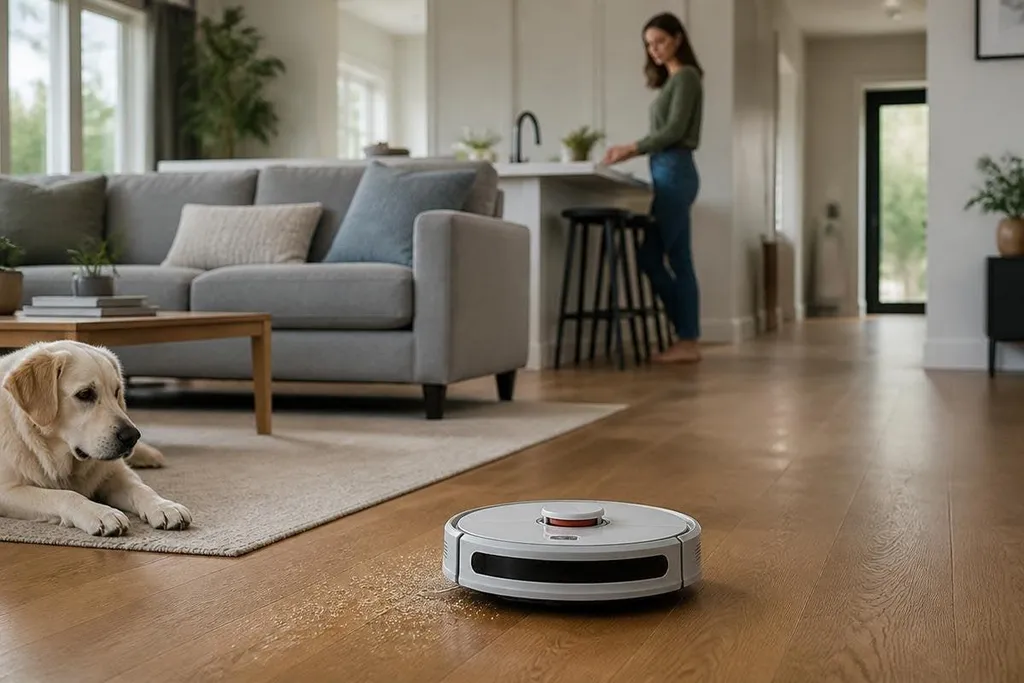
A home robot has to do more than move around a room. It has to handle a dull task, fit into a busy home, and ask for little daily care. That combination explains why household robots are getting closer to ordinary buying decisions, even when their limits are still clear.
- Repeated chores are the clearest reason to buy one.
- Sensors and software let robots work with less help.
- Price, repair, noise, and privacy still decide whether a robot belongs at home.
Repeated chores make the case
The first reason is simple: homes contain jobs that happen again and again. Floors collect dust, grass grows, pools gather debris, and litter trays need cleaning. Handling one of those jobs can earn its space by doing the same task on a schedule.
That schedule matters because the owner doesn’t need to remember each run. A robot vacuum can clean while people are out. A lawn robot can follow a set route rather than wait for someone to find time on the weekend. The benefit comes from repeated work, not from a machine having a human shape.
The task also needs a clear finish point. Vacuuming a floor has an obvious result. Folding mixed laundry does not, because fabric comes in different sizes and needs careful handling. Home robots are easier to accept when the job has fixed limits and few surprises.
Better sensing reduces daily work
A home robot needs to know where it is, what blocks its path, and when it should stop. Cameras, depth sensors, bump sensors, and mapping software help it make those choices. Mapping means building a working layout of the rooms, so the robot can plan where to move.
That hardware changes the owner’s role. Early machines often needed a clear floor and close watching. Newer systems can deal with table legs, room edges, and changes in the route.
Performance still depends on lighting, furniture, floor type, and software settings. The difference shows up in setup. If you must move chairs, hide cables, empty a bin, and rescue the robot after every run, the time saved shrinks.
A machine that returns to its dock, charges itself, and resumes work needs less attention, but it still needs brushes, filters, water tanks, or cutting parts checked at set times.
That upkeep belongs in the buying cost, and home robot coverage from Robot24.com can put a product's task beside its stated limits before the article turns to where these machines stop working.
The limits are part of the buying decision
Home robots work best in a narrow job. A robot mower can cut grass, but it won’t trim the edge beside a wall unless its design supports that task. A vacuum can collect dust, but loose cables, steps, wet spills, and small objects can still stop it or damage its parts.
Privacy adds another question. A robot with cameras or microphones may record information about the home, depending on its design and settings. You’ll need to check where data is processed, how long it is stored, and whether the robot can work without a cloud connection.
Repair also matters. A low purchase price can lose its appeal if the battery is sealed, replacement parts are hard to find, or the maker stops software support. I’d skip any home robot that hides its repair path, even if its chore list looks long.
A practical buying check
Use this list before you compare models:
- Name one chore: Write down the job, its frequency, and the part that takes the most time.
- Measure the space: Check door widths, floor changes, stairs, garden borders, and the robot’s dock location.
- Check the care work: Find out how often you’ll empty, wash, replace, sharpen, or clean each part.
- Read the data rules: Look for camera use, cloud storage, account needs, and deletion controls.
- Price the second year: Add consumable parts, batteries, bags, filters, blades, and service costs.
- Plan for failure: Decide what happens when the robot gets stuck, loses its map, or stops charging.
These checks separate a useful machine from an expensive object that still leaves the chore for you. They also explain why home robots appeal to more households: the best fit is narrow, visible, and easy to judge.
The next buying question is not whether a robot looks clever. It is whether one repeated task saves enough time to cover the purchase price, upkeep, and space it takes in your home.